Overview
HMI Smart Display Solution
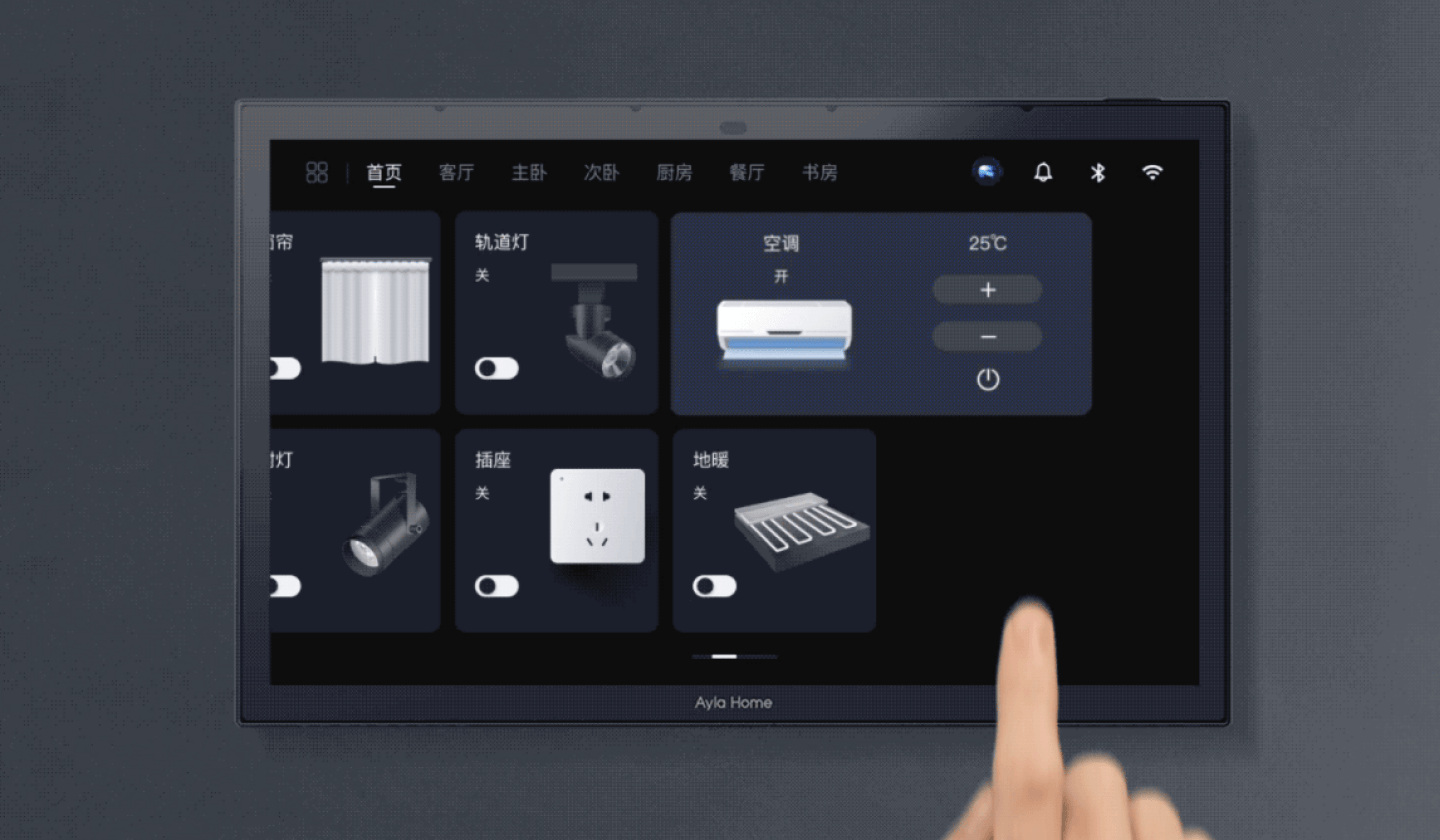
As IoT and AI continue to converge, intuitive and fluid human-machine interfaces are becoming a core competitive factor in smart devices. Traditional display solutions often suffer from limited interface options, complicated development, and high cost. FANlun provides a full HMI smart display portfolio tailored to different application scenarios and budget levels, with MIPI-DSI, RGB, and SPI display solutions based on ESP32-P4, ESP32-S3, and ESP32-C3 SoCs. The entire family integrates wireless connectivity, touch interaction, speech recognition, and more into a single chip, significantly simplifying hardware design. With a 400 MHz clock and hardware graphics acceleration, ESP32-P4 can drive 1920 ? 1080 displays; ESP32-S3 balances performance and cost for medium-sized smart-home control panels; and ESP32-C3 offers excellent value for compact appliance displays. With LVGL support, visual design tools, ESP RainMaker cloud integration, and Matter compatibility, the platform helps customers launch smart display products with professional user experience in as little as two to four weeks.
Applications
Industry Challenges
Difficult Interface Matching
Different screen sizes and use cases require different interfaces, forcing vendors to maintain multiple systems and raising cost and complexity.
Performance and Power Trade-Off
Balancing high-resolution display needs against battery-powered operation remains a difficult challenge.
High Development Barrier
Graphical interface development often requires specialized UI and UX teams that many smaller vendors cannot afford.
Complex System Integration
Wireless connectivity, touch, speech, and other multimodal interactions often require multi-chip cooperation and complicate design.
Fragmented Ecosystems
Different smart-home ecosystems are incompatible, leading to a fragmented user experience.
Cost Pressure
Traditional approaches require extra MCUs for display processing, increasing BOM cost by 30% to 40%.
Difficult Updates
Firmware and UI upgrades often require trained personnel on site, pushing up maintenance cost.
Our Solution
HMI Smart Display Solution
FANlun's HMI smart display solution spans three SoC platforms to cover full-scenario demand. The high-performance ESP32-P4 supports MIPI-DSI and can drive 1920 ? 1080 full-HD displays, with a built-in JPEG codec and 2D graphics accelerator that can improve frame rate by 300% in complex UI tasks. The balanced ESP32-S3 supports RGB displays, runs at 240 MHz with 512 KB SRAM, and fits 480 ? 800 smart-home control panels. The cost-efficient ESP32-C3 supports SPI displays, runs at 160 MHz, and drives compact 240 ? 240 or 240 ? 320 screens for small appliances and portable devices. The full product family uses a single-chip architecture that integrates Wi-Fi or Bluetooth 5 connectivity, touch processing, speech recognition, and other capabilities, eliminating many communication bottlenecks found in traditional designs. On the software side, the solution is built on ESP-IDF and deeply integrates LVGL together with SquareLine Studio, enabling high-quality interface design without heavy coding. Matter and ESP RainMaker support further enable cross-ecosystem device control and remote management. From prototyping to mass production, we provide complete evaluation kits and technical documentation to significantly shorten development cycles.
Core Capabilities
01Full-Interface Hardware Platform
High-performance MIPI-DSI solution on ESP32-P4 with 1920 ? 1080 support, 400 MHz processing, and 768 KB SRAM for smooth animation.
Mainstream RGB solution on ESP32-S3 with 240 MHz performance and 480 ? 800 support, balancing capability and cost.
Cost-effective SPI solution on ESP32-C3 with 160 MHz operation, 240 ? 320 support, and very low power draw for longer battery life.
Hardware acceleration on ESP32-P4 through JPEG codecs, 2D-DMA, and PPA modules, tripling image-processing efficiency.
Wide interface compatibility across MIPI-DSI, RGB, 8080, SPI, I2C, and related display standards.
02Integrated Software Ecosystem
Deep LVGL integration with full support for the graphics library and more than 60 UI components and animation effects.
Visual development tools in SquareLine Studio for drag-and-drop UI design without deep coding expertise.
Matter protocol support for cross-ecosystem interoperability and smart-home platform openness.
Seamless cloud integration through ESP RainMaker for device management, remote control, and OTA updates.
Voice interaction integration through the ESP-SR framework for wake-up and command recognition.
03Professional Development Support
Complete evaluation kits including ESP32-P4-Function-EV-Board, ESP32-S3-LCD-EV-BOARD, and other development platforms.
Reference design resources such as PCB layout guides, schematics, and BOM lists.
Mass-production optimization services covering the entire process from prototype to manufacturing, including certification and testing.
Power optimization guidance with dynamic frequency scaling and low-power mode tuning to extend runtime.
Industry-specific customization for healthcare, industrial, consumer electronics, and other verticals.
Customer Value
Shorter Development Cycles
Complete reference designs and tools can reduce time to market by 50%.
Optimized BOM Cost
Single-chip integration of wireless connectivity and display control reduces component count by 40%.
Upgraded User Experience
Smooth interfaces and multimodal interaction can improve user satisfaction by 35%.
Market Differentiation
Matter compatibility and cross-ecosystem control expand the reachable user base.
Lower Maintenance Cost
Remote diagnostics and OTA update capability can reduce after-sales issues by 60%.
Lower Technical Barrier
Visual UI design tools remove the need for a specialized graphics development team.
Faster Product Iteration
A modular software architecture shortens the time needed to add new functions by about 70%.
Reduced Certification Risk
Pre-certified wireless modules and complete compliance guidance lower certification failure risk.
Long-Term Ecosystem Assurance
Continuous software updates and long-term supply commitments protect product life cycles.